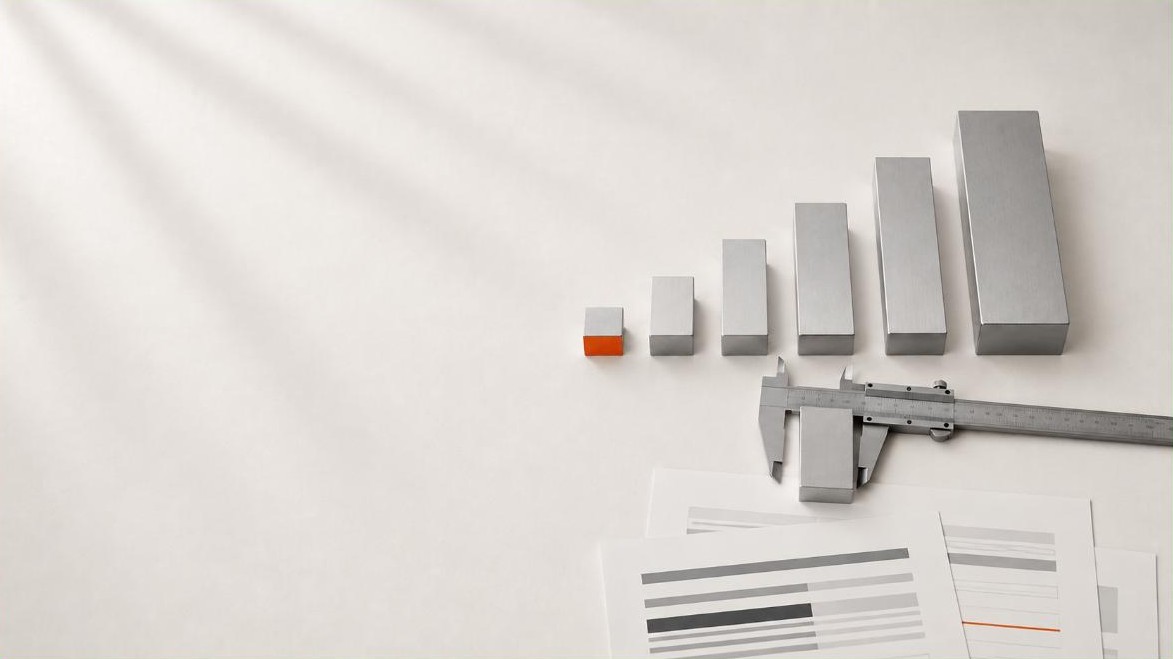
How much does custom software cost and what drives the price
There is no standard price for a custom software project. Two companies in the same industry can need very different systems in terms of logic, integrations and volume of work. That is why we estimate the project after we understand the process and define the first phase worth building.
Below you will find the factors that influence cost the most and how we get from a business problem to a concrete estimate.
See custom software developmentWhat the cost of custom software depends on
- A configurator with a handful of options and one with hundreds of rules can look similar on screen, yet involve completely different volumes of work.
- Integrating with your ERP, stock management, CRM or invoicing can be a minor part of one project and one of the main components of another.
- Cost follows the complexity of your process, not a screen or page count.
- A standard price set before we understand the project would mean either an estimate that is far too broad or cutting features later to stay within budget. We prefer to estimate after the audit, when it is clear what has to be built.
What influences the cost most
How many rules the system has to handle
The number of options, the rules between them, exceptions and commercial conditions directly influence project complexity. In a configurator or quoting system this logic can account for a large part of the development.
How many systems have to communicate
Invoicing, stock, ERP, CRM, couriers or other applications. Every integration has to be analysed and tested separately, depending on how each system allows access and data exchange.
How well the existing data is organised
If products, variants and prices are spread across five different spreadsheets, organising and validating them becomes a phase of the project.
How many people and roles use the system
An app used by a single person quoting is different from a system where sales, production, installation and management all work with different access and actions.
How fast it has to be delivered
A shorter deadline does not reduce the volume of work. If the project has to be delivered in a very tight window, it may require more resources or a different split of phases.
Where does your project start from?
Before we estimate the cost, what already exists matters too. Most situations we meet look like one of these.
Everything in spreadsheets and over the phone
Quotes are made by hand, everyone has their own file, and prices get verified by asking around.
Where we could start: a quoting configurator for one product line
See the CPQ configuratorYou have software, but it doesn't communicate
You already use invoicing, CRM, stock management or other applications, but the same information is transferred between them by hand.
Where we could start: automating a single data transfer between two systems
See system integrationsSystems are connected, but visibility is missing
The flow works, but you don't see quickly enough what the margin is, where delays appear or how long an order takes from quote to delivery.
Where we could start: a dashboard built on the data you already have
See dashboards and reportingWhy we don't publish a generic range
A range on a website would lump together projects that cannot be compared: a pilot on a single process and a system with several connected modules end up at completely different budgets. A generic figure would be more misleading than useful.
The estimate comes after the audit. In 48 hours we look at the current process, define the first phase and state explicitly what is in it and what is not.
Based on that definition we estimate the volume of work — how many flows are involved, which integrations are needed, how many business rules have to be translated into software and what data has to be pulled from existing systems. You get a budget for the first phase, not for the whole system; further phases are estimated separately, once the first one has been validated.
How we split the project to keep the budget under control
We don't estimate a large system as a single block. We split the project into phases, each with a clear result and a budget that can be evaluated separately.
Audit
Free · 48 hours. We look at the current process and decide where it makes sense to start.
Example and estimate
We build a prototype on your own case, define the first phase and estimate the work and budget involved.
Pilot
We put a single process into real use to validate the solution before extending the project.
Roll-out
Further phases are estimated and approved separately, after the pilot has been validated.
Questions about the cost of a software project
What drives the amount of work
The layers below are the ones we discuss before estimating a project.
- processes
- roles
- exceptions
- product rules
- existing systems
- API
- data migration
- screens
- reports
- training
- maintenance
Get an estimate for your case
In the audit we look at the current process, identify what is worth building first and define an initial phase that can be estimated realistically.