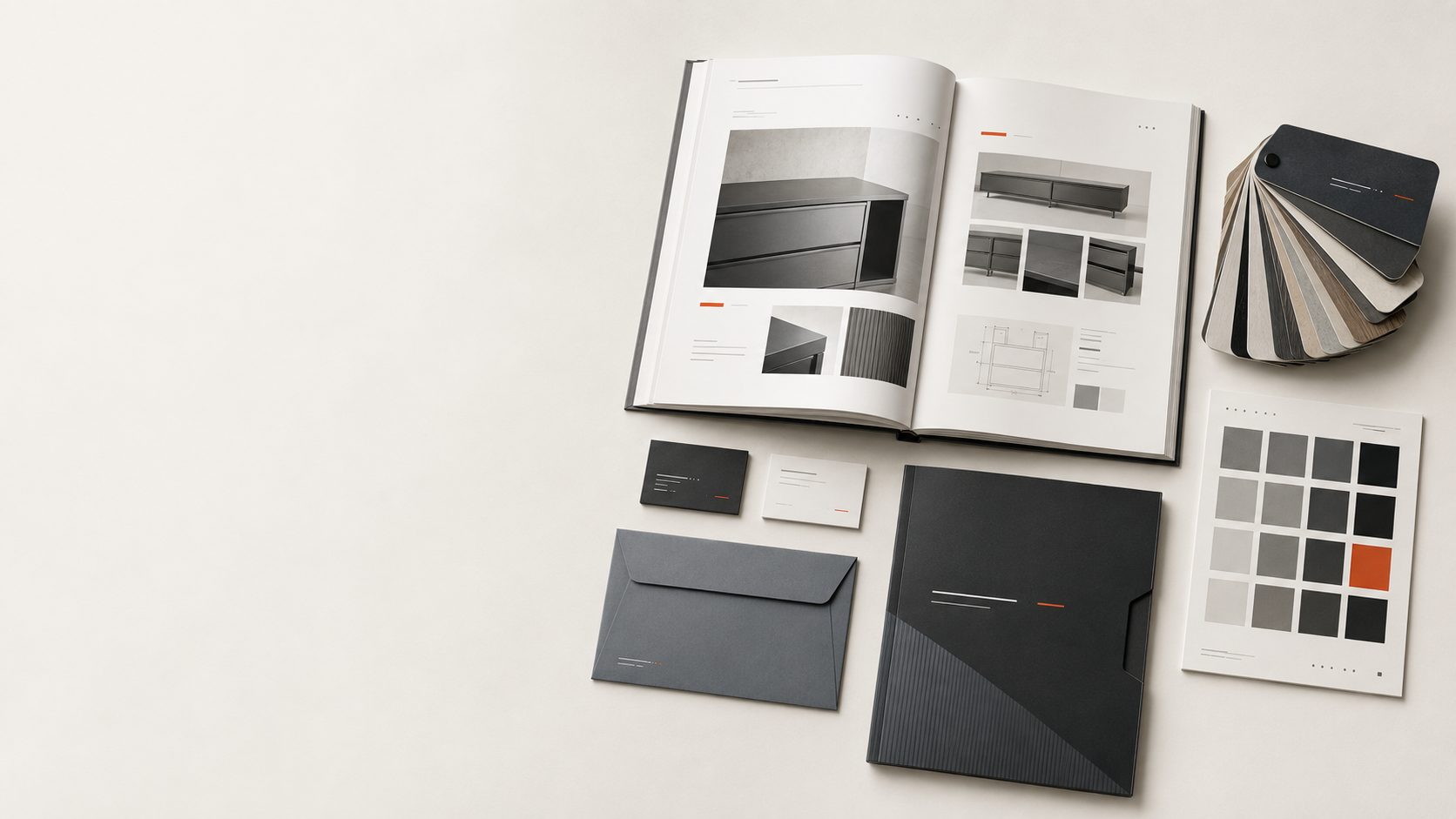
Branding and visual identity for manufacturers
From the brand identity to catalogues, the showroom, trade fairs and the materials the sales team uses.
A brand has to work equally well on the website, in a catalogue, on a trade fair stand and on the installation team's van.
If every material looks like it came from a different company, the problem is not a lack of design — it is the lack of a coherent visual system.
At VIBEZ we build visual identities and apply them to the materials the team actually sells with: catalogues, product sheets, showroom samples, signage, trade fair stands, print, photo and video.
For manufacturers, branding does not end at the logo. The product has to be presented clearly in the showroom, in the quote, in the catalogue and in the campaigns that bring the customer there.
When the visual identity needs more coherence
Not every company needs a full rebrand.
Sometimes the logo can stay and only the way it is used needs sorting out. Other times the business has grown, the range has expanded, and the materials have been left behind.
It becomes visible when the site, social media and printed materials use different styles, the catalogue no longer reflects the current range, every salesperson builds their own presentations, or the trade fair stand no longer communicates the same image as the website.
Just as often, the company has a premium product but presents it through photos taken on different phones, PDFs built in different periods and materials with no shared visual hierarchy.
We start from what already exists and decide what to keep, what to correct and what is worth extending.
What a coherent visual identity includes
Logo and usage variants
We define or refine the main mark and the variants you need in real contexts: horizontal and vertical formats, light and dark background versions, small sizes and print applications.
Colour palette and typography
We set the colours and fonts that can be used consistently across the website, social media, commercial documents, catalogues and physical materials.
Graphic elements
We build the system around the logo: iconography, shapes, patterns, photographic style and composition rules.
That lets a new material look like part of the same brand even when the logo is not the main element.
Tone and communication rules
Identity is not only visual. We set how headlines, commercial messages and product explanations are written, so the site, the catalogue and the campaigns do not speak in three different styles.
Brand applications
We turn the identity into the materials the company actually uses: business cards, documents, presentations, folders, templates and other relevant touchpoints.
Elements of a complete brand
Logo
The brand's visual symbol
Color palette
Colors that define the brand
Typography
Official fonts
Tone of voice
How the brand communicates
Graphic elements
Patterns, icons, shapes
Applications
Business cards, letterhead, etc.
Catalogues and product materials
For a manufacturer the catalogue is not decoration. It is a sales tool.
A good catalogue helps the customer, the architect, the dealer or the buyer understand the range without extra explanation on every page.
Depending on the product we can organise ranges and collections, variants and finishes, sizes, options, product photography, installed projects, technical sheets and example configurations.
We prepare the materials for print and for digital distribution, so the same structure works in the showroom, over email or in the hands of the sales team.
Sample displays and showroom materials
When texture, profile, colour or finish drives the buying decision, a photograph is not always enough.
We can build the visual concept for samples, boards and presentation materials so the customer can compare variants easily and the sales team does not improvise the product explanation every time.
The sample display has to work together with the catalogue and the website: same names, same codes, same hierarchy of the range.
Trade fair stand and signage
A trade fair stand has very little time to explain who you are and what you make. That is why we do not treat it as a large banner.
We start from the product on show, the visitor's path and the information that has to be understood from a distance. Then we build the graphics and materials around them.
We can prepare the stand concept, backdrops, panels, roll-ups, handouts, signage for the showroom, office or production hall, plus storefront and vehicle graphics.
The goal is a physical presence that is recognisable and consistent with the rest of the brand, not a different identity for every event.
Product and project photo and video
Owned visual material is one of the most useful assets for a company selling physical products.
We photograph the finished product, the production process and installed projects. From the same session we can prepare material for the website, social media, catalogue and campaigns, so no channel starts from zero.
Depending on the project we can include product photography, workshop images, finished jobs, filming of production or installation, short social video and drone footage where the perspective helps.
The result is your own visual library, organised and reusable.
Detailed services
From concept to implementation — complete branding and offline marketing.
Product catalogue and sample display
What the buyer keeps on their desk after leaving the showroom.
What we do:
- Catalogue per range, with configuration options and sizes
- Product sheets for architects and technical offices
- Finish and profile sample display for the showroom
- A print version and a PDF to send by email
- Visual identity consistent with the site and the campaigns
Benefit: Materials your customer can pass on inside their own company
Trade fair stand and signage
In manufacturing, fairs still bring contracts.
What we do:
- Stand concept and graphics, built around the product on show
- Roll-ups, backdrop, banners and handouts
- Signage at the office, showroom and production hall
- Vehicle graphics for installation teams
- Production and installation coordination
Benefit: A physical presence that matches the product you make
Product and project photo and video
The material that campaigns and the catalogue live on.
What we do:
- Photos of finished products, in the workshop and installed
- Filming the production process and installation
- Short social video cut from the same footage
- Drone footage for large projects
- An asset archive usable in print too
Benefit: Your own image library instead of stock photos
Types of offline materials
Outdoor signage
Volumetric letters, light boxes, totems
Indoor signage
Panels, signs, decorations
Print advertising
Flyers, brochures, catalogs, posters
Mobile displays
Roll-ups, X-banners, pop-up walls
Wraps
Vehicles, storefronts, walls
Events
Stands, backdrops, giveaways
How we work
Visual audit
We look at the current identity and everywhere it is used: site, social media, catalogues, documents, showroom and existing materials.
Direction
We decide what to keep, what to rebuild and which materials have commercial priority.
Visual system
We build or refine the identity and define the rules used across every application.
Application
We prepare the materials needed for online, print, showroom, events or the sales team.
Production and delivery
Where the project includes physical materials, we prepare the files and coordinate production or installation with the suppliers involved.
Pricing
Photo/video materials
An optional service for companies that constantly need visual content for the website, social media and campaigns.
Branding and Signage
The budget depends on what already exists, the number of materials, the complexity of the identity and the production needed.
The layers of a usable identity
An identity becomes useful when it reaches the materials used in selling every day.
- logo
- colours
- typography
- usage rules
- catalogue
- product sheet
- presentation
- quote
- stand
- signage
- packaging
- vehicles
Good brand, but the materials no longer keep up with the business?
Show us what you use today — site, catalogue, presentations, showroom or fair materials — and we will identify where the coherence breaks and what is worth rebuilding first.